
Medicare & Health Scams — Scammers steal your Medicare number to bill for services you never received — and leave you with damaged insurance records that can be hard to fix.
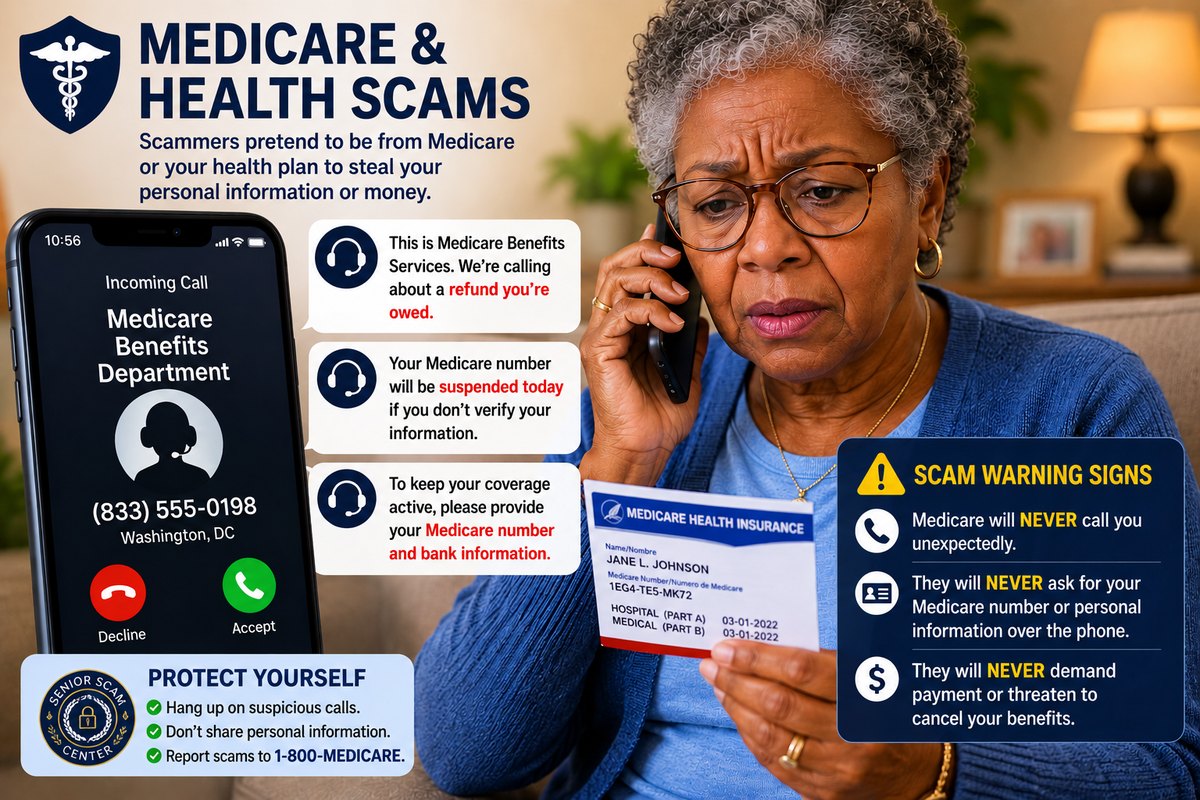
How Medicare Scams Work
Your Medicare number is as valuable as your Social Security number. Criminals use it to bill Medicare for expensive equipment, procedures, and services that were never provided — pocketing hundreds or even thousands of dollars per number.
Common Medicare scams include:
- •Fake card renewal: A caller says your Medicare card is expiring and you need to verify your number or pay a fee to get a new one. Medicare cards don't expire.
- •"Free" health screenings: Scammers offer free tests at health fairs or over the phone, then use your Medicare number to bill for services that were never given.
- •Fake drug discount cards: These cards don't work and are just used to collect your personal and Medicare information.
⚠️ Most Important Rule
Medicare will NEVER call you first to ask for your Medicare number, personal information, or payment. If someone calls you claiming to be from Medicare, it is a scam.
The Free Equipment Scam
One of the most common Medicare frauds involves "free" medical equipment — braces, wheelchairs, CPAP machines, or diabetic supplies. You receive an unsolicited call, an ad online, or even a visit offering free equipment covered by Medicare.
All they need is your Medicare number to "process the claim." Once they have it, they bill Medicare for expensive equipment — sometimes equipment you never received, sometimes far more than any item costs. You may receive junk you didn't need, or nothing at all. Either way, your Medicare is billed for thousands of dollars.
The damage is real: your Medicare benefits may be used up, and legitimate claims may be denied.
$60+ Billion
Estimated annual loss to Medicare fraud according to the National Health Care Anti-Fraud Association. Durable medical equipment fraud is among the most common schemes.
Open Enrollment Fraud (Oct 15 – Dec 7)
Medicare's Open Enrollment period runs from October 15 through December 7 each year. This is when Medicare beneficiaries can switch plans, and scammers take full advantage.
During this period, you may receive calls, mailers, or emails from people claiming to be Medicare advisors, insurance agents, or "plan specialists" offering to help you find better coverage. Some are legitimate — many are not.
Scammers use Open Enrollment to collect your Medicare number and personal details, switch you to a plan that pays them large commissions (but is worse for you), or steal your identity under the guise of "plan enrollment."
⚠️ During Open Enrollment
Never give your Medicare number to someone who contacts you first. If you want to compare plans, use Medicare.gov directly or call 1-800-MEDICARE (1-800-633-4227) to speak with an official representative.
Warning Signs & What To Do
- •Anyone who calls you claiming to be from Medicare — Medicare doesn't make outbound calls.
- •Offers of free equipment in exchange for your Medicare number.
- •Requests to "update" or "verify" your Medicare or Social Security number.
- •Charges on your Medicare Summary Notice (MSN) for things you never received.
✅ Review Your Medicare Summary Notice
Check your Medicare Summary Notice (or Medicare account at medicare.gov) regularly for claims you don't recognize. Catching fraud early limits the damage.
✅ Report Medicare Fraud
Call 1-800-MEDICARE (1-800-633-4227) to report suspected fraud. You can also report online at oig.hhs.gov. Reporting can result in up to $1,000 reward if your tip leads to a conviction.