
Investment & Financial Scams — Promises of guaranteed returns, secret investment opportunities, and "you've won" calls are all designed to drain the savings you've spent a lifetime building.
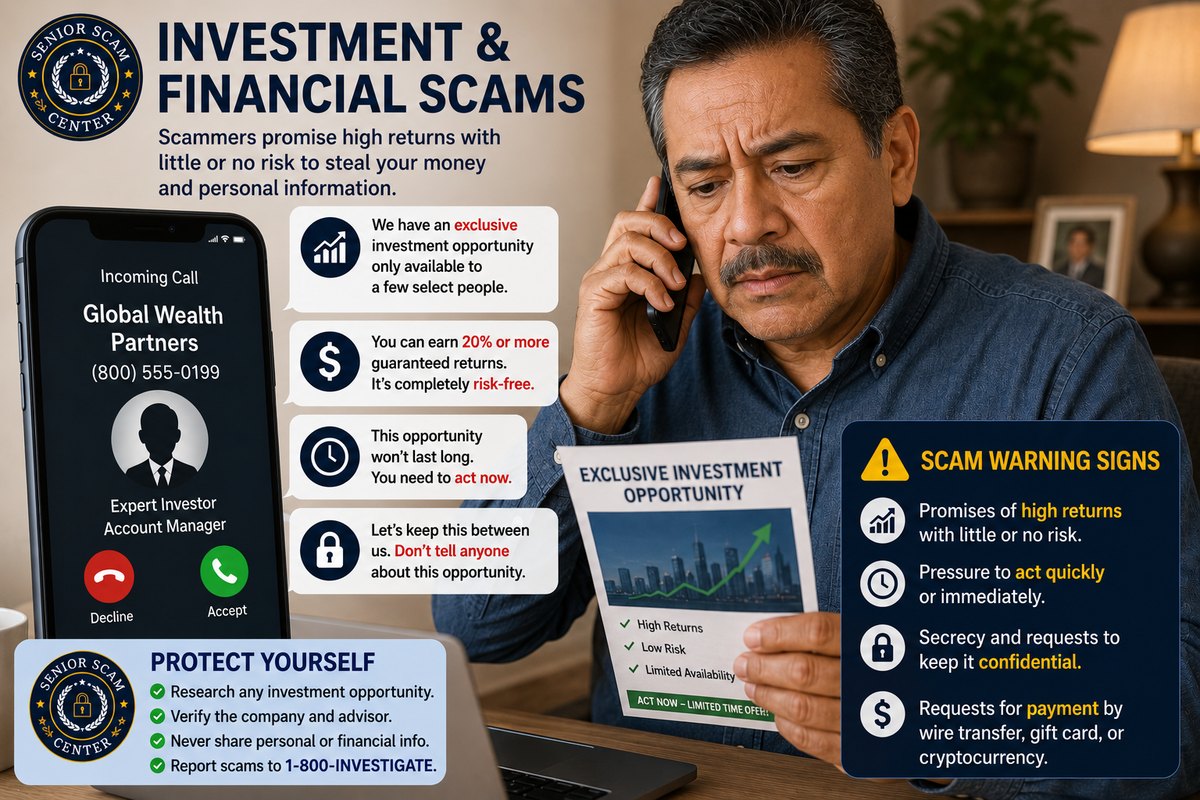
"Too Good to Be True" — Guaranteed Returns
The most reliable signal of investment fraud is the promise of guaranteed, high returns with little or no risk. In the real world, every legitimate investment carries some risk. Anyone who promises otherwise is lying.
Fraudulent investments often promise 10%, 15%, or even 30% guaranteed annual returns — far above what any legitimate bank, bond, or fund offers. They may show you fake account statements showing your money "growing" beautifully. They often recruit through trusted community networks — churches, ethnic communities, professional groups — because it's easier to convince people when there's a trusted face involved (affinity fraud).
⚠️ The Golden Rule of Investing
If an investment promises guaranteed high returns with no risk, walk away. This is true 100% of the time. Even U.S. Treasury bonds — the safest investment in the world — don't guarantee returns.
Cryptocurrency Fraud
Cryptocurrency — Bitcoin, Ethereum, and hundreds of others — is real, but it is also the preferred payment method of scammers worldwide. Once cryptocurrency is sent, it is virtually impossible to trace or recover. Scammers exploit this.
Crypto investment scams often come packaged with a fake trading platform that shows your investment growing rapidly. Scammers encourage you to invest more and more. When you try to withdraw, you're hit with "taxes," "fees," or told you need to deposit more to unlock your funds. It is all fake — the platform, the profits, and ultimately your money are gone.
Crypto ATM machines at gas stations and pharmacies are also widely used by scammers. If anyone tells you to deposit cash into a Bitcoin ATM to pay a debt, avoid a fraud, or claim a prize — that is a scam.
$5.6 Billion
Lost to cryptocurrency fraud in 2023 according to the FBI — a 45% increase from the prior year. Investment fraud accounts for the largest share of all crypto losses.
Lottery & Prize Fraud: You Can't Win What You Never Entered
You receive a call, letter, or email: "Congratulations! You've won $850,000 in the Publishers Clearing House lottery!" or "You've won a free cruise — just pay the port fees!" The catch is always the same: you must pay something first to claim your prize.
The fees keep growing — taxes, customs, insurance, legal fees. Victims can lose tens of thousands of dollars chasing a prize that was never real. The prize money never arrives.
Real lotteries and sweepstakes do not require you to pay to claim your winnings. Ever. And you cannot win a lottery you never entered.
⚠️ Absolute Rule
You never have to pay money to receive prize money. Anyone who says otherwise is running a scam. Hang up.
Warning Signs & Who to Report To
- •Guaranteed returns — no legitimate investment guarantees profit.
- •Pressure to act immediately — "This offer expires tonight."
- •Investment "opportunity" from someone you only know online or through social media.
- •Asked to pay fees before receiving prize or investment proceeds.
- •Advisor is not registered with FINRA or the SEC (you can check at finra.org/brokercheck).
✅ Verify Before You Invest
Check any financial advisor at finra.org/brokercheck (free). Check investment firms at investor.gov. Only work with licensed, registered professionals.
✅ Report Investment Fraud
Report securities fraud to the SEC at sec.gov/tcr or call 1-800-732-2992. Report commodity and crypto fraud to the CFTC at cftc.gov/complaint. Report all fraud to the FTC at reportfraud.ftc.gov.